
What Does the Casino Dealer Do on Soft 17?
For most people who walk through the doors of a casino with the intent to play blackjack, the tension rarely builds from hitting twenty. This point can also be viewed alongside mino casino review for additional context. It tends to build from the moment the casino dealer turns over an Ace paired with a Six. Known as a soft 17, this hand carries a strange split: it can be treated as seven, or it can be treated as seventeen depending on what comes next. The reason so many players fix their eyes to it is because the answer to what the dealer does with it is not universal from one casino to the next. For anyone trying to get a handle on that split before sitting down for the first time, looking over a plain rule breakdown such as can be enough to show just how much this one hand can vary from place to place. From that single card combination alone, the pace of the entire felt can shift without warning.
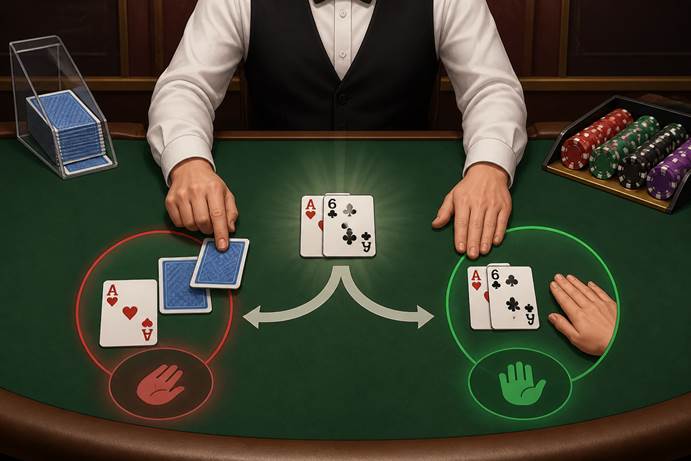
The core of the matter is purely procedural. A casino that follows a "stand on soft 17" approach has its dealer leave that Ace-Six alone once it is made, turning their cards over as a completed total of seventeen. A casino that follows a "hit on soft 17" approach has that same dealer take one more card in the exact same situation, hoping to improve a hand that is still flexible without the immediate threat of busting from adding a small card. Neither choice is arbitrary for the people working it. The dealer has no say in it at all. Long before any chips hit the felt in that casino, a rule was set down for the table and the dealer is expected to follow it every time without deviation. For players, the hand looks identical on the surface, but the outcome path for the rest of the round can quietly change because of that single mandate.
|
Area |
What to know |
|
Context |
What makes this so easy to miss is the way a soft hand behaves. |
|
Consideration |
For the dealer, none of this breeds hesitation. |
Understanding One
What makes this so easy to miss is the way a soft hand behaves. With any hard seventeen, a dealer would be done regardless of setting. With a soft 17, the Ace leaves room to dodge busting on the very next card. That flexibility is exactly why the question of what the dealer does on soft 17 carries weight. In one casino, drawing to that flexibility is encouraged by the table rule. In another casino, the rule locks it in place as is. To someone who has only ever played at one blackjack table, it can feel strange to find a different course of action across town. Yet for anyone that moves between casinos with any regularity, seeing the same exact Ace and Six met with a stand in one room and a hit in the next becomes one of the first clear lessons that blackjack procedure is not stamped onto every door the same way.
• Neither choice is arbitrary for the people working it
• For players, the hand looks identical on the surface, but the outcome path for the rest of the round can quietly change because of that single mandate
• Yet for anyone that moves between casinos with any regularity, seeing the same exact Ace and Six met with a stand in one room and a hit in the next becomes one of the first clear lessons
• A trained casino dealer does not weigh odds across the felt or guess at what the players at their box would prefer
• The players may lean in, shift in their seats, or quietly track the next card with more focus than they did for most of the dealer’s play, but from behind the table there is no debate
Dealer and Its Practical Impact
For the dealer, none of this breeds hesitation. A trained casino dealer does not weigh odds across the felt or guess at what the players at their box would prefer. The motion is mechanical by design. After dealing out the hands, once it falls to the dealer’s own hand to play, the eyes go straight to the total type. If it is a soft 17 and the house rule says stand, the hand stays. If it is a soft 17 and the house rule says hit, the dealer draws the next card off the shoe with no break in the flow of the round. The players may lean in, shift in their seats, or quietly track the next card with more focus than they did for most of the dealer’s play, but from behind the table there is no debate. That detachment is not coldness, it is simply the job: carry out the rule for that casino exactly as written for that table.
Rule and Its Practical Impact
It is worth keeping in mind that this has more to do with procedure than pressure. A lot of blackjack talk revolves around big totals or going over twenty one, yet the moment that causes the most private recalculations for sharp eyed players is often this oddly unassuming pair. In some casinos, hitting soft 17 gives the dealer a tiny bit more room to catch a better total, which is the entire reason that rule exists for those casinos in the first place. In casinos with the opposite rule, keeping a soft 17 as is is the chosen route. No matter which route a given casino takes, the player is not expected to talk a casino dealer out of it. The rule applies to every round at that table with no exceptions. Knowing that distinction is far more useful than trying to argue a rule that is already in motion.